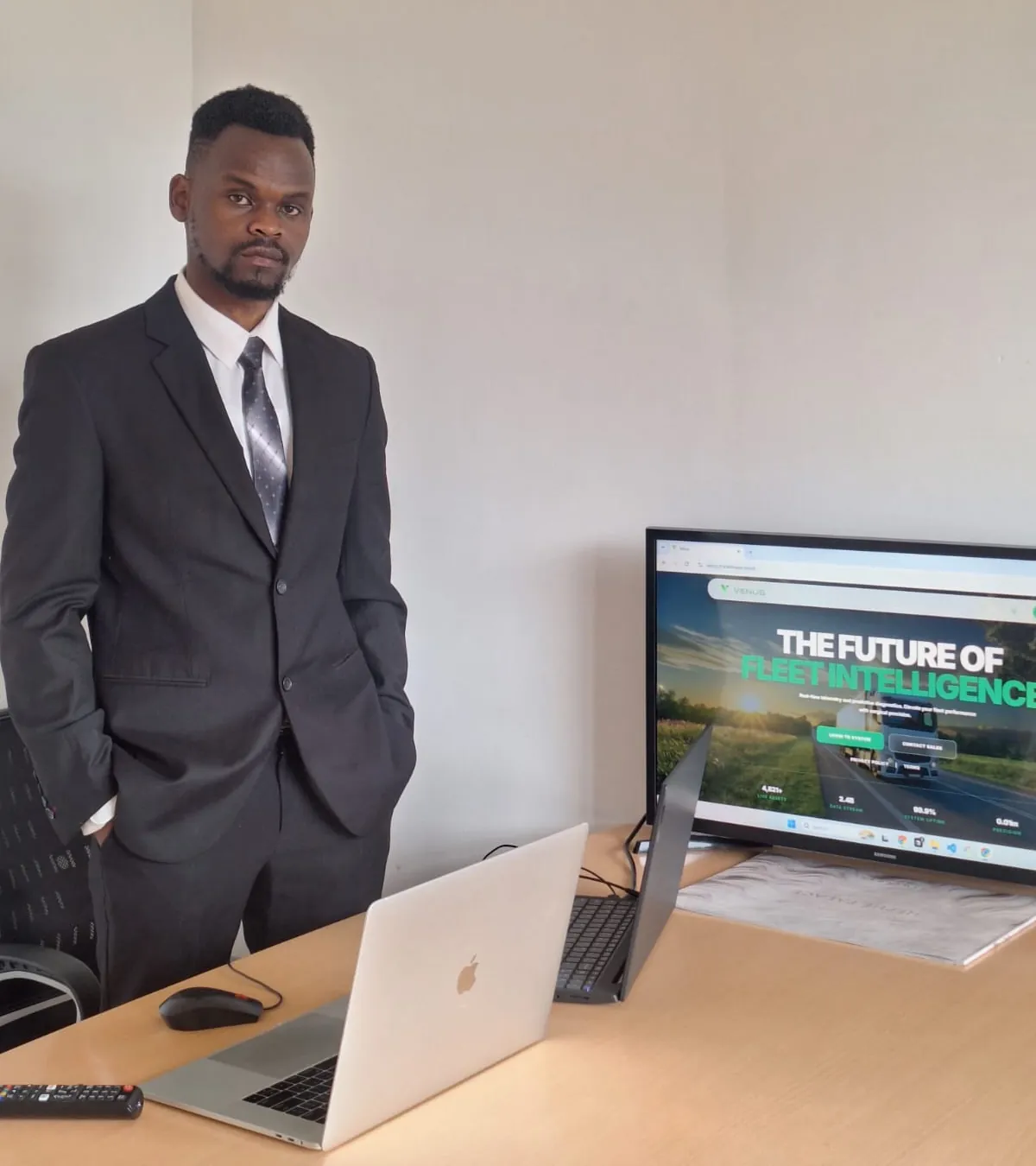
There is a voice that has been speaking to me for as long as I can remember.
I do not mean this as a figure of speech. I mean that before I had a word for code, before I knew what a server was, before I had ever built anything another human being could use, there was a voice in my head telling me to make things. It came as ideas. As pictures. As an urging I could not explain and could not ignore. Build this. Keep going. Do not stop.
For most of my life, I thought it was only me in there. I thought I was the kind of person who had to dream alone.
I was wrong about that. But it took a long time, a great deal of failure and one very strange evening to understand whose voice it was.
This is a story about a mind that could not stop seeing. And about the voice that kept it building when the world kept telling it to stop.
Three Dimensions
The mind sees in three dimensions.
When most people look at a login screen, they see two boxes and a button. When I look at it, I fall through the surface. I see the email field and the emoji someone will paste into it. I see the Wi-Fi dropping in the millisecond between the click and the server. I see ten thousand people clicking at once, and the whole thing bending under them. I cannot help it. The surface is never the whole story.
A truck on a highway is not a truck. It is fuel, and speed, and a driver’s foot on a pedal, and a load that must arrive, and a hundred small things that can go wrong between here and there. A school bus is not a bus. It is a child who must not be left behind, and a parent waiting for a message that says: she is on. She is safe.
For twenty-six years I did not know what to do with this. I was just imagining.
The Cord
I need to tell you where the sight came from, because it explains everything that follows.
My mother tells it like this. Ten months. Not nine — ten. I arrived when I was ready and not a moment sooner, as if I had already decided the world would have to wait. I weighed four and a half kilos, heavier than any of my siblings. I would not let anyone pick me up. I did not cry much.
And the umbilical cord was around my neck.
It had been there the whole time. The thing that was supposed to feed me, to keep me alive, had wrapped itself around my throat. It had to be cut for me to breathe.
A few months later, the convulsions started. My parents did not know what was happening. They took me to a doctor, and the doctor looked at me and said I would grow up to be a cabbage.
I have been sitting with that sentence for most of my life. A man in a white coat looked at a baby and said: this one will not become anything. And for a while, it seemed he might be right. As a toddler I was slow. The prophecy was tightening around my neck the way the cord had, and there was no surgeon this time.
Then something happened. I cannot fully explain it, and I have stopped trying. All I can tell you is that at some point I began to be the best. I do not know how that cord got cut. I only know I was the one holding the blade, in the dark, and that no one saw me do it.
That is the first thing I ever understood about the world: the thing that feeds you can also strangle you. The umbilical cord. The doctor’s word. The room that says not your habitat. It is always the same shape. Find the cord. Cut the cord. Breathe.
I have been cutting ever since.
The Long Nights
But cutting a cord does not give you a home. It only gives you breath.
The world still did not have a place for a mind like mine. I studied Telecommunications. I did not picture myself in software. I did not picture myself building the things I build now. I had a degree, and the sight, and no idea that the two of them were waiting for the same door.
There were nights. Many of them, more than I will admit. I sat in front of a screen I did not fully understand, learning things no one was teaching me: how to write code, how to put it out into the world, how to make a machine do what I could see in my head. My friends were out. My life was passing. I was alone in a room with a glowing screen, and I would think: I am missing out.
I thought I had to dream alone. I have always had to. I have always been drawn to the extremes. The long nights, the silent rooms, the work no one sees. Loneliness is the tax on a certain kind of seeing.
But there was a voice in my head. There have always been ideas and inspirations, a speaking, an urging, something that would not let me sit still. Since last year it has gotten louder. Keep going, it says. Keep building. Even when it is hard. Even when no one is watching. Even when you think you are dreaming alone.
I used to think dreaming alone was a curse. Now I think it was the only way the voice could be heard.
The Fear
I need to tell you about the fear, because nobody warns you about it.
Before Venus, I had built things. But Venus was different. This was a platform that teams of developers had tried to build and failed to bring to life. Whole teams. And here I was, one person, alone, with a Telecommunications degree and a voice in my head, tasked with doing what they could not.
I would sit in the room and think: what if I fail? Not quietly. Not as a passing worry. As a weight that sat on my chest every morning and was still there at midnight. What if I am the one who cannot do it?
Then one evening, a GPS tracker was sitting on my desk. I had been building for weeks. Venus was not even deployed yet. No clients, no fleet, nothing anyone could see. And I sent the signal.
A location icon appeared on the map. A place. A time.
That was it. A small icon on a screen, telling me where a device on my desk was, and when. But it was a burst of life breathed into Venus. The tracking engine had come alive. The thing I had been imagining for weeks, the thing whole teams had failed to build, was for the first time real enough to say: here. Now.
I sat there for a long time. The fear did not leave. If anything, it got bigger, because now I could see how much was left: fuel monitoring, video, the backend orchestration waiting at the VPS, the whole weight of what I had promised to build. The first step had only shown me the size of the mountain.
But the foundation was there. I had made a thing that worked.
I went back to the chair.
The Spreadsheet
But before Venus, there had been Track IQ.
The company had people whose job was to call clients when their speed governors or tracking devices had expired. That was the business: the renewals, the compliance, the relationships that kept the fleets on the road and the money coming in. And the way they did it was this: a spreadsheet, filtered by date, and then a phone call. One by one. By hand.
Every expired device that slipped through the filter was money leaking out and a client falling out of compliance. The business was not broken, exactly. It was strangling slowly, the way a cord does, and no one had noticed because it had been that way for so long that it looked like the way things were.
I noticed. I built Track IQ. It takes the data from the tracking systems and sends the reminders by itself. Then I went further and made it renew the certificates too. I did not build a feature. I found the cord around the operation’s neck and I cut it.
That was the first cord I cut with code.
Then came Venus.
I built it this year, starting in February. Ten months, from nothing to a platform that tracks vehicles, watches fuel, watches drivers, watches video, manages trips, keeps cold chains cold, and gets children on and off school buses safely. And it answers the questions fleet owners actually ask. Not where is my vehicle? The harder ones. Why is the fuel disappearing? Which driver is burning out the clutch? Which truck will break down next week?
For years, this industry has promised intelligence and delivered dots on a map. A dot tells you where. It never tells you why. And the answers, when they came at all, came from far away: from India, from Europe, from companies that built for other roads and other markets and sold the leftovers to ours.
Venus is that cord, cut.
Eleven thousand three hundred and ninety-five vehicles on the dashboard. A truck on Thika Road, moving at sixty-nine kilometres an hour, because a system in Nairobi knows where it is and what it is doing. A school bus with a fingerprint reader that tells a parent the moment their child gets on. A lock on a fuel tanker crossing a border where the power is never guaranteed. Trucks in Lusaka. Trucks in Arusha. Built here, for matatu owners and petroleum transporters and school administrators, not in a lab abroad.
Ten months. I went looking for a company in this country that had built its own system like this, one that was not imported from Europe, white-labelled from Asia or rented from a platform abroad. I struggled to find one. Most of the industry runs on systems someone else made. Until Venus, so did the company I build for. Venus is ours.
Not Your Habitat
I want to tell you what the computer science guy said when he saw it.
“This is not your habitat.”
He said it kindly, I think. The way you tell a man he has walked into a place he cannot survive. He was inside the world of code. I was a Telecommunications engineer who had wandered into his room.
He was wrong. Not because I proved I belonged in his habitat — I did not, and I never will. He was wrong because the habitat was never his to give. I did not enter it. I built a different one, on different ground, for people he had never thought about: matatu owners, petroleum transporters, the parent waiting for the school bus message.
He looked at me and saw someone out of place. I looked at him and saw a man who had never once had to build the room he stood in.
The Voice
I used to think I was dreaming alone.
I know now that I was not. The voice that kept telling me to build, through the long nights, through the learning, through the loneliness. I know whose it is. It is the voice of I AM. The One who is, and was, and will be. I did not arrange the keeping. I only obeyed the building.
The voice of I AM, and the mind that built Venus.
I do not think I taught myself to see in three dimensions. I think I was kept, and shown, and given the thing to build. The umbilical cord was cut before I could cut it. The doctor was wrong before I could prove him wrong. The nights were lonely before the voice got loud. None of it was an accident. I was not supposed to be here, and yet here I am.
Midnight
It is late again as I write this. The router is still blinking. Somewhere on a road I cannot see, a truck is moving, and a system in Nairobi knows where it is and where it is going.
I think about the cord, sometimes, when I am deploying at midnight. I think about the surgeon’s hands, and the doctor’s word, and the spreadsheet with its quiet leak. I think about all the cords I have had to cut — some with a blade, some with code, some with nothing but the decision to go back to the chair.
The first cut was made for me, before I could breathe.
Every one since has been mine.